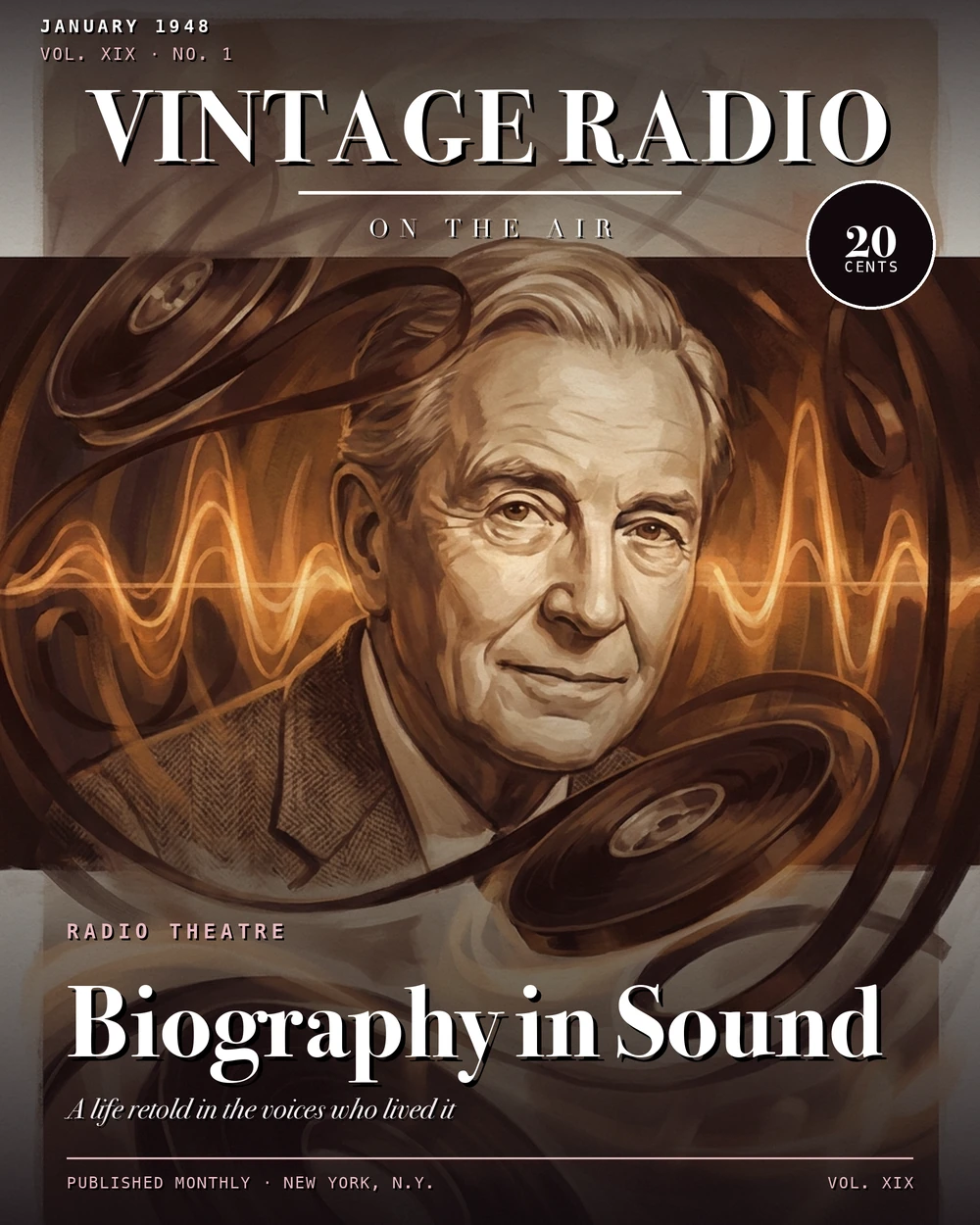
Biography In Sound
The Idea Behind It
The most important thing to understand about Biography in Sound is what made it technically possible at all. In 1949, NBC newsman Joseph O. Meyers started quietly building a tape library at the network, beginning with a brief segment of Joe Louis announcing his retirement from boxing. By 1954, that library held more than 150,000 historic statements, all transferred to tape and indexed for retrieval. Without that archive, the show couldn't have existed. With it, Meyers had the raw material to do something no one else on radio was doing: let the subjects of biographical documentaries speak for themselves, in their own voices, from recordings made across decades.
Meyers's concept was to blend those archival recordings with fresh recollections from the subject's friends, associates, and antagonists — the people who were actually in the room. The result wasn't a reading of a Wikipedia entry over mood music. It was closer to oral history, with the subject's own voice woven through the testimony of everyone who knew them. That combination of recorded actuality and living witness gave the series a texture that print biography and television profile couldn't match.
How It Started
The series began as a one-off. NBC assigned Meyers to produce a single documentary for Winston Churchill's 80th birthday, November 30, 1954. For that program, Meyers brought in publisher Bennett Cerf to tell Churchill anecdotes — both serious and amusing — and had Laurence Olivier and Lynn Fontanne read from British poetry. Sound effects and music were added for dramatic effect. The industry response was striking. Radio Life said Meyers had "done the impossible" by turning "people's attention once more to radio."
About a month later, Meyers produced a documentary on Ernest Hemingway, which drew similar notice. A biography of Gertrude Lawrence followed roughly a month after that. By February 1955, NBC had seen enough. The format was converted from occasional documentary to weekly series, with "Meet Carl Sandburg" airing February 20, 1955, as the first weekly installment. The show ran on various days over its four-year life — Sundays, Thursdays — but mostly on Tuesdays, at 9 p.m. Eastern, in a 60-minute slot.
The Shape of an Episode
Each installment followed a recognizable structure. The subject's archival voice appeared early, establishing that this person actually existed and sounded like a human being rather than a chapter heading. From there, the episode moved through testimony from friends, colleagues, and critics, typically including at least one witness to a defining moment in the subject's life. For musical subjects, significant work from their career ran through the program. The format was consistent enough that regular listeners knew roughly what was coming, which helped rather than hurt — the structure gave the producers a frame to hang the best material on, not a cage that limited it.
The Fitzgerald episode is a good illustration of how the format worked at its best. Editor William Hill assembled it using period jazz — Chicago and New Orleans styles — to evoke the flapper era. Guests included biographer Arthur Mizener, author of The Far Side of Paradise; millionaire Gerald Murphy and actress Lois Moran, the real-life models for Dick Diver and Rosemary in Tender Is the Night; and Paris correspondent Henry Wales. Time magazine reviewed the episode in 1955, calling it "a poignant re-creation of the tragic life and happy times of one of the most gifted American writers of the 20th century" and arguing that "radio at its nonvisual, imaginative best" had outperformed television's "gaudy resources" for this kind of storytelling. The episode's per-episode budget, as Time also reported: $500. The entire series was sustaining — unsponsored — which made that figure even more remarkable.
The Guests and the Subjects
The range of people who sat down for the series, either as profiled subjects or as guest commentators, reads like a list of mid-century cultural figures assembled at random from a very good party. The Hemingway episode featured Mickey Spillane, Gary Cooper, Al Capp, Leland Hayward, and Marlon Brando. The H.L. Mencken episode, broadcast July 10, 1956, and titled "The Bitter Byline," put Mencken's own voice alongside commentary from James T. Farrell, Alistair Cooke, and William Manchester. A May 15, 1956, episode titled "Recollections at 30" marked thirty years of network broadcasting and was narrated by pioneer newscaster H.V. Kaltenborn.
Subjects across the run included Thornton Wilder, George M. Cohan, Robert Benchley, Fiorello La Guardia, Herbert Hoover, Grantland Rice, Jerome Kern, Albert Schweitzer, Babe Ruth, John L. Lewis, Leo Durocher, Connie Mack, Knute Rockne, and Franklin P. Adams, among many others. A January 1958 episode on war correspondent Ernie Pyle carried the title "Typewriter in a Foxhole." The series occasionally expanded beyond individual biography into broader documentary territory — a 1956 episode titled "The Atom: Menace and Progress" examined atomic energy without organizing itself around a single person's life.
The series had no single permanent narrator. Instead, NBC News Department newscasters took turns, which gave individual episodes a slightly different feel depending on who was handling the narration. That rotating approach also reinforced the news-department identity of the series — this wasn't a dramatic production department making entertainment; it was the news operation making documentary radio.
What Held Up and What Didn't
The stronger episodes remain genuinely absorbing. The Hemingway biography has held up as strong radio for listeners who came to it decades after it first aired. The episodes on F. Scott Fitzgerald and Sinclair Lewis drew particular notice for the depth and clarity of their portraits. The Mencken episode benefited from having Mencken's own recordings to draw on alongside voices as varied as Cooke's and Manchester's.
The weaker episodes are a different story. Some of them were probably a little dull even when they originally aired. The Thomas Wolfe episode, for instance, gave strikingly brief treatment to Wolfe's reliance on and stormy friendship with his editor Maxwell Perkins — a relationship that was central to understanding Wolfe's career — which left the portrait feeling incomplete in a way that was hard to miss. The W.C. Fields episode has been cited as one that never quite gets its subject. The Stan Kenton episode, hosted by Frank Sinatra, has drawn notice as an unusual pairing — not entirely successful, by most accounts. These episodes didn't erase what the series accomplished, but they were a reminder that a weekly documentary format running for four years was going to produce some installments that worked better than others.
What Survives
The series ran through 1958, and a substantial portion of it is preserved. Close to 100 hours of Biography in Sound survive across multiple collections, representing the bulk of what was broadcast. The series has been credited with how it humanizes each of these personalities in ways not even the most prosaic eulogy or obituary ever could — and even figures as unlikely as financier Serge Rubinstein received the Biography in Sound treatment. A 1964 special produced in the same format has also survived alongside the 1954–1958 episodes.
What Meyers built, starting with that one Joe Louis recording in 1949, turned out to be the infrastructure for something that holds up. The format was smart, the tape library was deep, and the best episodes used both to produce portraits of public figures that went places print couldn't follow.